ISLAMABAD, Apr 12: The US and Iran have failed to reach agreement on ending
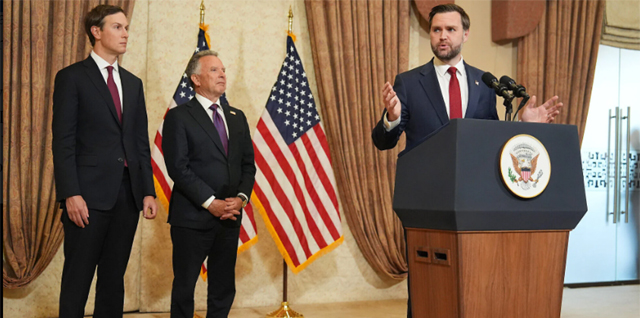
the Gulf war. Vice-President JD Vance, who was leading the US team, left Islamabad
on Sunday morning after a marathon 21 hours of negotiations that began on Saturday, and bore no fruit. Both sides blamed each other for making unreasonable demands.
Vance said Iran did not accept American terms, including to not build nuclear
weapons. Iran’s nuclear program is the central issue, the "core goal."
“The bad news is that we have not reached an agreement, and I think that’s
bad news for Iran much more than it’s bad news for the United States of America...
“So we go back to the United States having not come to an agreement. We’ve made
very clear what our red lines are,” he told reporters.
Vance said he spoke with President Donald Trump half a dozen times during the
talks.
“We need to see an affirmative commitment that (Iran) will not seek a nuclear
weapon, and they will not seek the tools that would enable them to quickly achieve
a nuclear weapon... That is the core goal of the President of the United States,
and that’s what we’ve tried to achieve through these negotiations,” Vance said.
A spokesperson for the Iranian Foreign Ministry said the talks were conducted
in an atmosphere of mistrust and it was unrealistic to believe an agreement
could be reached. Tehran is “confident that contacts between us and Pakistan,
as well as our other friends in the region, will continue,” he said. He said
the talks were "intensive." Washington must refrain from "excessive demands
and unlawful requests," he said.
Pakistan said it will try another round of negotiations.
There was no indication of what will happen after the current 14-day ceasefire
agreed to by the US, Iran and Israel. The prospect of a "hot war" in the Strait
threatens to negate the fragile ceasefire.
Australia’s Foreign Affairs Minister Penny Wong said, "It is disappointing
that the Islamabad talks between the United States and Iran have ended without
agreement. The priority now must be to continue the ceasefire and return to
negotiations. We continue to want to see a swift resolution to this conflict.
Any escalation in the conflict would impose an even greater human cost and further
impact the global economy."
President Donald Trump had a while earlier threatened that more ships were
being loaded with fresh ammunitions for a renewed assault on Iran in case the
talks broke down.
For the peace talks in Islamabad, delegations led by Vance and senior Iranian
officials met behind closed doors under Pakistani mediation. While initial reports
suggested a "10-point plan" was under consideration, the talks reportedly stalled
late Saturday night.
Three critical "red lines"
- Maritime control: Iran’s demand for the right to charge "tolls" and inspect
ships passing through the Strait of Hormuz.
- Asset freezes: Iran’s insistence on the immediate release of $6 billion
in frozen funds currently held in Qatar.
- Nuclear guarantees: Trump’s administration has pivoted to a "99% focus"
on the total dismantling of Iran’s nuclear infrastructure—a condition Tehran
continues to reject as a violation of its sovereignty.
"The gap remains wide," a senior diplomatic source stated. "The 15-hour marathon
ended not with a signature, but with a pause for 'internal consultations'".
While diplomats were debating in Islamabad, the US Central Command (CENTCOM)
announced that two guided-missile destroyers—the USS Frank E. Peterson and the
USS Michael Murphy—successfully transited the Strait of Hormuz.
Admiral Brad Cooper, CENTCOM commander, described the move as a "mine-clearing
operation" aimed at restoring the free flow of global commerce. For over six
weeks, the Strait has been effectively closed by Iran, causing global oil prices
to skyrocket.
Trump took to social media to celebrate the manoeuvre, stating that American
forces have begun "clearing out" the waterway as a "favor" to allies who lacked
the "will" to do so. He further characterized the move as a demonstration that
Iran is "losing big" despite their threats to "obliterate" any intruding vessels.
Two US warships cross Strait of Hormuz
Even as the US-Iran talks started in Islamabad on Saturday amid a fragile ceasefire
and hit an indefinite pause late in the night after a gruelling 15-hour negotiations,
two US warships crossed the dangerously mined Strait of Hormuz for the first
time since the war began on February 28.
(The US announcement of “two warships crossing” Hormuz refers to destroyers—USS Frank E. Petersen and USS Michael Murphy— to clear the mines laid by Iran to block the Strait, and not the carriers. Ford and Lincoln stay put outside the Gulf, in the Arabian sea, close to Oman.)
IRGC’s denial
The Iranian military and the Islamic Revolutionary Guard Corps (IRGC) have
issued a sharp rebuttal, flatly denying that any American warships entered the
Strait. Ebrahim Zolfaghari, a spokesperson for Iran’s Khatam al-Anbiya Central
Headquarters, called the US claims "fictional" and "psychological warfare."
"The initiative for the passage of any vessel lies exclusively with the armed
forces of the Islamic Republic," Zolfaghari told State media, warning that any
genuine attempt to breach the waterway would be met with "firmness and full
resolve."
The breakdown in talks and the maritime friction have sent fresh shockwaves
through global markets. With nearly 20% of the world's crude oil typically passing
through this narrow chokepoint, the prospect of a "hot war" in the strait threatens
to undo the fragile two-week ceasefire that had briefly lowered tensions.
Gulf has no access to Red Sea: The Persian Gulf has no direct, natural
or navigable sea access to the Red Sea, making the Strait of Hormuz the sole
exit point into the Gulf of Oman and the Indian Ocean. Consequently, ships cannot
leave the Persian Gulf without passing through this narrow, high-risk chokepoint.
The Persian Gulf is enclosed by land on all three sides, with the only exit
being the strait to the southeast.
While some countries (e.g., Saudi Arabia) have pipelines to transport oil to
the Red Sea, maritime traffic must pass through the 33km-wide narrowest point
of the strait. Around 20% of the world's total oil consumption passes through
this strait.






 )
)