MUMBAI, Feb 4 (INS): It was myhem at the Mumbai airport for quite some time
on Tuesday evening. A major ground safety incident occurred at the Chhatrapati
Shivaji Maharaj International Airport (CSMIA) as an Air India and an IndiGo
aircraft clipped wings while manoeuvring on the airport’s congested taxiway
network. Here is a play-by-play account.
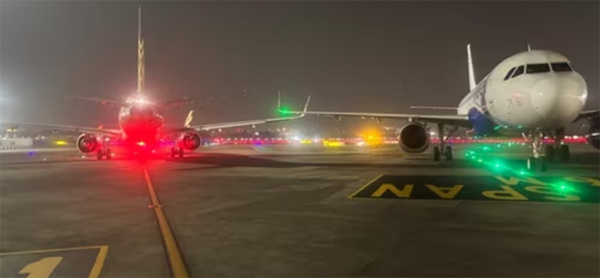
The incident, which took place around 7:32 pm, involved Air India flight AI
2732 (Mumbai to Coimbatore) and IndiGo flight 6E 791 (Hyderabad to Mumbai).
Both aircraft were Airbus A320s and were carrying a combined total of over 320
people at the time of the impact.
According to the Directorate General of Civil Aviation (DGCA), the Air India
flight was taxiing from taxiway C1 toward M4 (bypass for runway) for departure.
At the same time, the arriving IndiGo flight was entering taxiway B1 after landing.
As the two narrow-body jets passed one another, their right wingtips—specifically
the "sharklets" or wing-end fences—brushed against each other.
"The wingtips of the two aircraft made contact, resulting in damage to our
aircraft's wingtip," an Air India spokesperson confirmed. IndiGo issued a similar
statement, noting that their aircraft is currently undergoing maintenance inspections.
While Mumbai’s taxiways are designed to accommodate A320-sized aircraft with
specific clearance margins, the airport’s "hot spots"—areas where multiple taxiways
intersect—require extreme precision.
Investigators are currently looking into whether one of the aircraft had deviated
from the painted yellow centreline, which provides the necessary lateral clearance
for wingtips.
Fortunately, no injuries were reported among the 146 passengers on the Air
India flight or the 174 on the IndiGo flight. However, the collision caused
immediate operational disruption. Both aircraft were forced to return to their
respective bays for emergency technical evaluations, and passengers were deboarded.
Air India passengers faced significant delays as a replacement aircraft had
to be arranged for the Coimbatore leg.
The DGCA has launched a formal investigation into the mishap. Officials are
analyzing ground radar data and Air Traffic Control (ATC) recordings to determine
if the instructions given to the pilots were clear or if there was a lapse in
situational awareness in the cockpit. The incident has renewed calls for stricter
ground movement protocols at Mumbai, which remains one of the world’s busiest
single-runway operations
How did it happen: AI 2732 was navigating toward the M4 connector—a
vital "on-ramp" to the main runway—while IndiGo flight 6E 791 was exiting the
runway via Taxiway B1.
The collision occurred at a known "hot spot" where several taxiway links converge.
Data suggests that while the taxiway design meets international safety widths
for the Airbus A320, the "safety buffer" is less than a few metres when two
such aircraft pass each other. If one aircraft is even slightly off the painted
yellow centreline, their wingtips—which span nearly 36 metres (118 feet)—are
at risk of contact.
The taxiways in Mumbai are like "lanes" leading to a single highway entrance.
To get from a specific gate to the runway, a plane often has to cross the path
of planes that have just landed and are heading to their gates.
While taxiways are designed with strict safety margins, several factors can
lead to "wing clipping":
Taxiway Hierarchy: Taxiways have specific "codes" (A through F) based
on the wingspan of the aircraft they can accommodate. If a pilot inadvertently
takes a slightly tighter turn or deviates even a few feet from the yellow centreline,
the safety buffer disappears.
Parallax & Perspective: From a cockpit that is 30–50 feet in the air,
judging the exact distance of a wingtip (which is 50+ feet behind and to the
side of the pilot) is extremely difficult. Pilots rely on the centreline for
guidance; they cannot actually see their own wingtips.
Congestion & "Hot Spots": Mumbai is one of the world's busiest single-runway
operation airports. During peak hours, taxiways are packed. If one aircraft
is slightly over the "hold short" line or a parking bay line while another is
passing, a collision can occur.
Human Factor: It often comes down to a momentary lapse in coordination
between the Ground Controller and the cockpit, or a "look-but-fail-to-see" error
during complex manoeuvres.
AI 2732 was heading out to Coimbatore. It was taxiing from Taxiway C1 toward
M4 (a common path to get to the take-off point).
IndiGo 6E 791 had just landed from Hyderabad. It was taxiing in the opposite
direction, joining Taxiway B1 to head toward its parking bay.
As they passed each other at an intersection, the right wingtips of both Airbus
A320 aircraft scraped. Because both planes are the same model, their wings are
at the exact same height, making a "mid-air" clip on the ground much more likely
if they aren't perfectly centred.
Why didn't taxiway design prevent this? Taxiways are designed to be
safe, but Mumbai is one of the most space-constrained airports in the world.
It uses parallel taxiways to handle its massive traffic. Sometimes, if one
aircraft is a few feet off the "yellow line" (the centreline) or if an aircraft
is a slightly wider variant than the taxiway was originally built for, the "safety
buffer" shrinks to almost nothing.
Reports indicate the Air India plane was actually waiting or stationary on
the taxiway for its turn to take off when the arriving IndiGo plane tried to
manoeuvre past it.
What is M4? M4 (Mike 4) is a specific "exit/entry ramp" or connector.
At Mumbai, M4 is a crucial link that connects the main taxiway to the takeoff
point of the runway. In other words it is the name of a taxiway link. Think
of the runway as a "highway" and the taxiways as "service lanes." The "M" stands
for "Mike" in aviation phonetics. When ATC (Air Traffic Control) tells a pilot
to "Taxi via M4," they are giving them a specific "GPS route" on the ground
so they don't run into other planes.
The Air India flight (AI 2732) was moving toward this "ramp" (M4) to get in
line for takeoff.
The IndiGo flight (6E 791) had just landed and was moving on a parallel lane
(B1) to get back to the terminal.
Because both were Airbus A320s, their wings are at the exact same height.
If one plane is just a few feet off its yellow centreline that 15-metre safety
buffer disappears. Their wingtips—which extend far beyond what a pilot can see
from the cockpit—simply "shook hands."
The damage: The impact resulted in visible structural damage to the
wingtips (sharklets) of both aircraft. The "common man" may wonder how two modern
jets can collide on a regulated tarmac. Aviation experts point toward the high-density
traffic at Mumbai airport. "While taxiways are designed with international standard
separation clearances, even a minor deviation from the yellow taxi-line by either
aircraft can bridge the safety gap," noted a former flight safety officer.
The DGCA has launched a high-level investigation into the mishap. "Both aircraft
have been pulled from service for technical inspections. We are analyzing the
Black Box (Flight Data Recorder) and ground control transcripts to determine
if this was a result of pilot error, a miscommunication from Air Traffic Control
(ATC), or a lack of proper ground markings," a DGCA official stated.
The incident caused a temporary ripple of delays at the airport as ground teams
cleared the debris and inspected the taxiway for safety. Both Air India and
IndiGo have expressed regret for the inconvenience, maintaining that passenger
safety remains their "highest priority."
Is there only one runway? Technically, No—there are two. They are laid
out in a "cross" or "X" shape ($09/27$ and $14/32$).The Reality: Because they
ntersect in the middle, they cannot be used at the same time. Most of the time,
Mumbai operates as a single-runway airport. If one plane is landing on the main
runway, the other runway is effectively blocked. This creates a massive "bottleneck"
where all planes from all gates are trying to get to the same strip of tarmac.
Planes parked at Terminal 1 (Domestic) and Terminal 2 (International) all need
to reach the same runway. Depending on the wind direction, planes might need
to take off from one end of the runway or the other. That is aerodynamics vital
for takeoffs. This requires them to cross other taxiways (and sometimes the
secondary runway) to reach their "starting line."
Is the Entry/Exit from the runway the same? No. Planes enter at the very beginning
of the runway (the threshold) and exit at various points along the runway (Rapid
Exit Taxiways) so they can get out of the way quickly for the next plane to
land. The collision happened because, in the rush to get planes "in" and "out"
of these various points, two planes were directed into a narrow "corridor" (the
intersection of Taxiways B1 and C1) at the same time.





 )
)