DHAKA, Feb 13 (INS): In the first national election since the 2024 uprising, the
Bangladesh Nationalist Party (BNP), led by Tarique Rahman, son of former Prime
Minister Khaleda Zia, has secured a decisive landslide victory.
The one-day voting for Bangladesh's 13th parliamentary election and a referendum
for constitutional changes had concluded on Thursday evening and counting started
soon after. Early results were out by Friday morning.
While the vote was described as largely peaceful by officials, it was marred
by scattered clashes, crude bomb blasts, and the death of at least one political
leader.
The unofficial results indicate a major shift in the parliamentary landscape.
The BNP has secured an absolute majority, with reports indicating it has won
between 151 and 211 seats in the 300-seat parliament.
Opposition Jamaat-e-Islami, which led an 11-party alliance including the National
Citizen Party (NCP), is expected to emerge as the primary Opposition with approximately
41 to 70 seats.
Voters also cast ballots for the "July Charter," a package of constitutional
reforms including prime ministerial term limits. Early counts suggest this referendum
is likely to pass.
The Election Commission reported a final turnout of 60.69%.
Poll violence
Despite the deployment of over 900,000 security personnel, several violent
incidents were recorded. At least one death was reported—BNP leader Mohibuzzaman
Kochi died following a scuffle at a polling centre in Khulna.
Approximately 72 people were injured in 14 separate clashes across the country.
Notable incidents occurred in Noakhali (31 injured) and Bagerhat (19 injured).
Awami League stronghold Gopalganj was rocked by violence overnight. Ten cocktail
explosives were fired. Crude bomb blasts occurred at the Reshma International
School in Gopalganj, injuring three people including two Ansar security members
and a child.
A young Hindu tea garden worker was brutally murdered in the Moulvibazar area
of northeast Bangladesh. A crude bomb blast at a polling centre disrupted voting
in Munshiganj.
Election Commission senior secretary Akhtar Ahmed said nowhere voting was suspended
and there was no serious incidents or disturbances.
Authorities detained multiple individuals for alleged irregularities, including
the recovery of over 100 pre-stamped ballots in Sherpur-1 and vote-buying allegations
in Chuadanga.
A 'safe' Bangladesh for all
This election marked the first time in nearly two decades that the Awami League,
led by ousted former Prime Minister Sheikh Hasina, did not participate as her
party was banned. The Awami League’s electoral symbol, boat, therefore, did
not appear on the ballot paper. Its registration was suspended. Hasina, currently
in India, labeled the polls a "farce" and demanded a fresh vote.
“According to the Election Commission’s briefing, by 11 a.m. — just three and
a half hours into voting — only 14.96% of eligible voters had participated,”
she said in a statement.
In contrast, BNP's Tarique Rahman has promised a "safe Bangladesh for all"
following his party's return to power. He is a contender to head a new government.
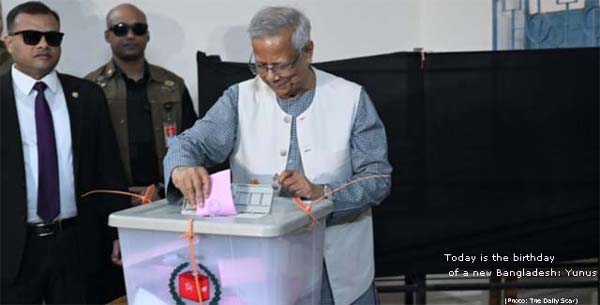
Head of the interim Government Mohammad Yunus said the election is “the beginning
of an unprecedented journey toward a new Bangladesh.”
There were 55,454 observers from 81 local organisations and 394 from foreign
countries as poll monitors.
A total of 1,755 candidates from 50 political parties and 273 independents
contested the election in 299 (out of 300) constituencies.
The high profile candidates in the field included NP’s strongman candidate
Mirza Abbas, National Citizen Party’s Nasiruddin Patowary supported by the 11-party
alliance led by Jamaat-e-Islami, Independent candidate Rumin Farhana in Brahmanbaria
and anti-Hasina uprising student leader Hasnat Abdullah from Comilla-4. Young
Islamist Sharif Osman Hadi of Inquilab Mancho was planning to contest from Dhaka-8
before he was shot late last year.
A profound "coming of age"
An expert's analysis: Bangladesh is currently experiencing a profound
"coming of age" moment, characterized by a major political, social and economic
transition following the student-led "July Uprising" of 2024 that ousted long-time
Prime Minister Sheikh Hasina.
The nation is now navigating a, transitional period, marked by the first general
election held on Thursday, featuring a high voter turnout and a shift towards
new political leadership under an interim government.
There is a visible political transformation. Following the 2024 uprising, the
country is undergoing a shift from authoritarian rule to a more competitive,
albeit uncertain, political landscape. The Bangladesh Nationalist Party (BNP)
emerged as a major force in the elections, aiming to overhaul the system.
In an economic evolution, Bangladesh is transitioning from a "least developed"
to a "developing" country, with graduation set for November 2026. It boasts
a higher per capita income than neighbouring India in some measures, with significant
growth in the textile industry and a budding startup ecosystem.
Here is the push and the dividend: With an average age of 26, the country is
driven by a young population that is actively seeking greater accountability,
economic opportunities and democratic freedoms.
Despite challenges, the country has achieved high rates of poverty reduction,
falling from 80% in 1971 to under 19% in 2022. It also leads in green factory
certifications.
However, the nation faces challenges, including a "structurally stagnant" economy,
potential for renewed political instability and the need for significant reforms
to prevent a return to previous, non-democratic or corrupt practices.
That is what exactly the silent operator Yunus' 84-point package is! May be
his economic theories, built into the structural changes envisaged, are working
advantage Bangladesh, a historically cursed land of perennial poverty.






 )
)