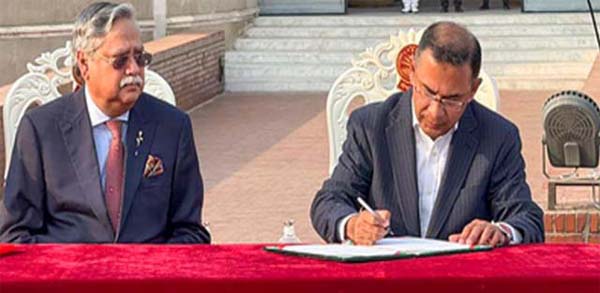
DHAKA, Feb 17: In a historic shift for South Asian politics, Tarique Rahman,
chairman of the Bangladesh Nationalist Party (BNP), was sworn in as the Prime
Minister of Bangladesh on Tuesday.
The ceremony marks the formal end of nearly two decades of political exile
for the BNP and the conclusion of the 18-month interim administration led by
Nobel laureate Dr Muhammad Yunus.
The swearing-in ceremony took place at the South Plaza of the Jatiya Sangsad
(National Parliament) rather than the traditional Bangabhaban (Presidential
Palace). This change was reportedly made to accommodate a massive guest list
of approximately 1,200 attendees, including foreign dignitaries such as India’s
Lok Sabha Speaker Om Birla, Maldives President Mohamed Muizzu and representatives
from Pakistan, Bhutan, and Sri Lanka.
President Mohammed Shahabuddin administered the oath of office to the 60-year-old
Rahman, son of former Prime Minister the late Khaleda Zia and the late President
Ziaur Rahman. In addition to the Prime Minister, a cabinet of 25 ministers and
24 ministers of state was also sworn in.
A new Bangladesh
The BNP’s return to power follows a decisive victory in the 13th parliamentary
elections held on February 12. The BNP secured a commanding two-thirds majority
with 209 out of 297 seats contested. Jamaat-e-Islami won a record 68 seats,
forming a significant portion of the new Opposition. The erstwhile ruling party,
Awami League of deposed prime minister Sheikh Hasina was barred from contesting
the elections.
This election was the first since the 2024 student-led "July Revolution" that
ousted the 15-year regime of Sheikh Hasina. It is also being hailed as the world’s
first "Gen Z-inspired" election, with high turnout among young voters who demanded
sweeping structural reforms.
Economic challenges and foreign policy
In his first address following the oath, Prime Minister Rahman called for national
unity and the rule of law, promising an era of "clean politics" and an end to
the "culture of vengeance."
On the economic front, he faces the challenge of managing 8.5% inflation and
rebuilding the vital garment export sector. On the foreign affairs front, he
needs to repair strained ties with India while managing infrastructure partnerships
with China.
Notably, Rahman is the first male Prime Minister of Bangladesh in 36 years,
breaking a long-standing "battle of the Begums" between Khaleda Zia and Sheikh
Hasina.
Continuity with Change: An analysis
The transition of power in Dhaka has introduced a blend of seasoned political
veterans and new "technocrat" faces, alongside a radical new constitutional
framework known as the July Charter.
The 49-member Cabinet (25 ministers and 24 ministers of state) reflects a strategic
effort to balance the BNP's traditional base with the reformist energy of the
student movement.
High-ranking members of the BNP National Standing Committee have taken senior
roles. This includes Mirza Fakhrul Islam Alamgir, Amir Khosru Mahmud Chaudhury,
and Salahuddin Ahmed.
To maintain stability during the transition from the interim government, Dr
Khalilur Rahman (formerly the National Security Adviser to Dr. Yunus) has been
appointed as the Foreign Minister. He is expected to lead the diplomatic push
on the Rohingya crisis.
In a nod to the 2024 revolution, Jonaid Saki of the Gonosanghati Andolan—a
popular figure during the student protests—has been sworn in as a Minister of
State.
For the first time in years, the cabinet includes members from minority communities,
including Nitai Roy Choudhury, emphasizing the "inclusive" mandate of the new
administration.
The July National Charter 2025 is the constitutional backbone of this new government.
Negotiated by 26 political parties and the Yunus administration, it aims to
prevent the return of autocracy.
No individual can serve as Prime Minister for more than 10 years (two terms).
Bangladesh will move from a single house to a bicameral system. A new 100-member
Upper House will be established via proportional representation to ensure smaller
parties have a voice.
The neutral caretaker system, which oversees elections to ensure fairness,
has been officially reinstated and constitutionally protected.
The Charter establishes an independent Judicial Appointments Commission, removing
the Prime Minister’s power to hand-pick judges.
Power is shifted from the Prime Minister’s Office toward the President and
Parliament. Notably, MPs are now allowed to vote against their party line on
most bills (except money bills), weakening the "party dictatorship" of previous
eras.
Alongside the February 12 election, citizens participated in a national referendum
to approve a Referendum Charter. With the BNP and its allies securing a "Yes"
vote, the newly elected Parliament will now act as a Constitutional Reform Council
to finalize these amendments within the next two years.






 )
)