HANOI, Aug 25: US Vice-President Kamala Harris' visit to shore up relationships
in South East Asia over regional economic issues and covid management and to
target China's territorial claims in the South China Sea faced an unexpected
disruption ranging up to four hours while preparing to fly to Vietnam after
the Singapore leg of her second overseas trip in office on Tuesday evening.
Her Guatemala visit was also hampered by some glitches early this year.
What led to the delay in her flight to Vietnam was a report emanating from
Hanoi that two diplomats had suffered an attack of the so far mysterious 'Havana
syndrome'. Harris eventually took off from Singapore's Paya Lebar Air Base at
7:32 pm local time on Tuesday.
Although presidential and vice-presidential trips can often run behind schedule,
such a long delay is said to be unusual.
"Earlier this evening, the Vice President's traveling delegation was delayed
from departing Singapore because the Vice President's office was made aware
of a report of a recent possible anomalous health incident in Hanoi, Vietnam.
After careful assessment, the decision was made to continue with the Vice President's
trip," said Rachael Chen, spokeswoman for the US embassy in Hanoi, in a statement
on Tuesday.
According to BBC, when the incident in Hanoi came to light Harris was in Singapore.
No details were given about the incident.
In a statement, the US State Department confirmed that Harris's departure from
Singapore to Hanoi was delayed after reports of a "possible anomalous health
incident" there.
A CBS News said that two officials had to be medically evacuated. It said "acoustic"
incidents were reported in the homes of two US diplomats, not the embassy.
To a question at the White House press briefing if there was a threat to the
travelling VP and staff, White House press secretary Jen Psaki said no "additional
assessments" have been made. "There was a decision made that she could continue
travel along with her staff," Psaki said. Those affected were not traveling
with Harris but declined to say how many individuals fell ill. Harris was not
medically evaluated because she was not on the ground at the time the incident
was reported, CNN reported.
Symptoms of 'Havana syndrome'
The symptoms of 'Havana syndrome' include vertigo, nausea, headache, hearing
unexplained sound (acoustic issues) etc which sometimes last years. There are
cases of incapacitated US employees taking premature retirement.
The cases were first reported from Havana in 2016 and therefore it is nicknamed
'Havana syndrome'. Thereafter cases were reported from US embassies all over
the world like China, Austria etc. The syndrome has sickened hundreds of American
embassy staff and other officials.
This year there were two cases reported close to the White House. Secretary
of State Antony Blinken's response so far has not been assuring.
The US has been unable to find out what or who cases this health issue.
There are unverified interpretations of what is causing the syndrome like ‘directed,
pulse radio frequency energies’; 'directed microwave radiation' etc. The US
refers to it as “anomalous health incidents.”
Some Canadian diplomats who were also affected while in Havana are suing their
Government for $21.1m in damage for negligence. BBC quoted one employee saying:
"My wife, she isn't the same anymore...She has gaps in her memory, headaches,
problems hearing. She picks up the telephone to make a call but forgets why,
enters rooms without reason."
China claim on South China Sea
In Hanoi, at a bilateral meeting with Vietnamese Prime Minister Pham Minh Chinh on Wednesday, Harris said that the one million doses of covid vaccine would begin to arrive within the next 24 hours.
During her meeting with Vietnamese President Ngyuen Xuan Phuc, Harris said
the US will send additional Coast Guards to Vietnam to help defend its security
interests in the South China Sea.
“We need to find ways to pressure and raise the pressure, frankly, on Beijing
to abide by the United Nations Convention on the Law of the Sea, and to challenge
its bullying and excessive maritime claims,” she said. The US plans to maintain
a strong presence in the South China Sea to challenge China, she added.
China, Vietnam, Brunei, Malaysia, the Philippines and Taiwan claim rights over
the South China Sea. Major sea routes pass through the sea and China objects
to foreign ships and asserts its sovereignty.
In Singapore also the US VP talked about South China Sea, US exit from Afghanistan
and covid management. In a speech at Gardens by the Bay in Singapore on Tuesday,
she outlined the Joe Biden administration’s plan for Indo-Pacific engagement.
Harris said Washington’s vision was one of “peace and stability, freedom on
the seas, unimpeded commerce, advancing human rights, a commitment to the international
rules-based order and the recognition that our common interests are not zero
sum”. “Our engagement in Southeast Asia and the Indo-Pacific is not against
any one country, nor is it designed to make anyone choose between countries,”
she said.


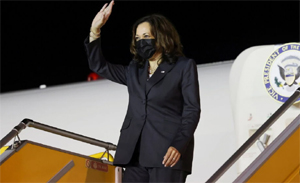 Kamala Harris' South East Asian friendship trip was all but
marred by an incident of the mysterious 'Havana syndrome'
seizing the American diplomats in Hanoi where she was heading
after her itinerary in Singapore on Tuesday evening. The visit was
delayed by four hours, which is unusual for presidential
incumbents. Incidentally, her first overseas trial run too had met
with some glitches while proceeding to Guatemala early this
year.
Kamala Harris' South East Asian friendship trip was all but
marred by an incident of the mysterious 'Havana syndrome'
seizing the American diplomats in Hanoi where she was heading
after her itinerary in Singapore on Tuesday evening. The visit was
delayed by four hours, which is unusual for presidential
incumbents. Incidentally, her first overseas trial run too had met
with some glitches while proceeding to Guatemala early this
year. 


 )
)