LOHARDAGA (Jharkhand), Jul 9 (INS): A 12-year-old girl died and three others
were hospitalized after a krait snake bit them while they were sleeping in their
room in the hostel of the Sanvasira Higher Secondary Residential School in Lohardaga
district, Jharkhand.
The snake attacked the four girls in their ground-floor room. One girl was
declared dead on arrival at the hospital, while the others remain in critical
condition.
The incident occurred on Tuesday night at the private residential school located
in Rocho Mahuatoli, under the jurisdiction of the Kuru police station.
The highly venomous krait entered the girls' room while they were asleep and
first bit 12-year-old Varsha Oraon. Her screams woke up other girls, but the
snake had already bitten the three others in the chaos.
Teachers rushed the four girls to Lohardaga Sadar Hospital, where Varsha was
declared dead. Two students are receiving treatment at the local facility, while
one has been referred for critical care at RIMS (Rajendra Institute of Medical
Sciences) in Ranchi.
Snakebite management
The standard medical protocol for managing a venomous snakebite focuses on
rapid stabilization, delaying venom spread and administering anti-snake venom
(ASV). In India, the standard guidelines follow the World Health Organization
(WHO) Snakebite Management Manual and the National Snakebite Management Guidelines.
1. Immediate first aid
The primary goal of immediate first aid is to keep the victim calm and restrict
venom movement until they reach a hospital
Keep calm: Reassure the victim. Panic increases heart rate, which circulates
venom faster.
Immobilize the limb: Treat the bitten limb like a fracture. Use a splint
or cloth bandage to keep it completely still.
Remove constrictions: Take off rings, bracelets, watches, or tight clothing
near the bite. The area will likely swell.
Keep at heart level: Position the bitten area at or slightly below the
level of the heart.
Transport rapidly: Move the victim to the nearest hospital capable of
administering anti-venom immediately
2. The Don'ts
Traditional myths often worsen snakebite injuries and lead to tissue damage
or faster venom absorption.
Do NOT cut or incise: Never cut the bite wound. It does not release
venom and causes severe bleeding.
Do NOT suck the venom: Do not use your mouth or commercial suction pumps.
It is ineffective and dangerous.
Do NOT use tight tourniquet (bands): Do not tie tight ropes or strings
around the limb. It cuts off blood supply completely and can lead to amputation.
Do NOT apply ice or chemicals: Do not apply ice, herbs, potassium permanganate,
or electric shocks to the wound.
3. Course of treatment
Once the patient arrives at a medical facility, healthcare providers follow
a systematic clinical protocol.
Triage and stabilization: Airway, breathing, and circulation (ABC) are
assessed immediately. Respiratory support is prepared, especially for neurotoxic
bites (like a Krait or Cobra).
Assessment for systemic envenoming: Doctors look for signs of venom
activity before giving ASV.
Neurotoxic signs: Drooping eyelids (ptosis), difficulty swallowing,
or muscle weakness.
Hematotoxic signs: Spontaneous bleeding from gums, non-clotting blood,
or bruising.
20-minute whole blood clotting test (20WBCT): A few millilitres of
blood are placed in a glass tube. If it does not clot after 20 minutes, it confirms
hematotoxic envenoming.
Anti-Snake Venom (ASV) administration: In India, a polyvalent ASV is
used. It neutralizes the "Big Four" species: Indian Cobra, Common Krait, Russell's
Viper and Saw-scaled Viper.
ASV is administered intravenously (IV), never locally at the bite site.
An initial dose (typically 8–10 vials) is started based on signs of severe
envenoming.
Monitoring and redosing: The patient is monitored continuously. If clotting
does not return to normal or neurological symptoms worsen, additional doses
of ASV are administered.
The Common Krait and the three others
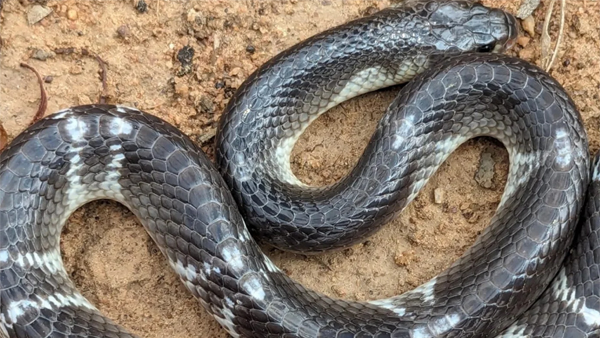
The species is nocturnal and is characterized by its black or bluish-black
body with narrow white crossbands, typically reaching lengths of 3 to 4 feet.
They are found in parts of tropical Asia from Iran through the Indian subcontinent.
The Common Krait (Bungarus caeruleus) possesses a highly potent neurotoxic
venom. This venom contains neurotoxins, such as ß-bungarotoxin, which specifically
affect the nervous system. Can lead to systemic muscle paralysis.
Often it has no intense local pain or swelling typically associated with other
venomous snakebites.
The Common Krait is one of the "Big Four" snakes in the Indian subcontinent.
The other three are:
- Spectacled Cobra (Naja naja): Its venom is primarily neurotoxic
and cytotoxic. It targets the nervous system and causes local tissue destruction
around the bite site.
- Russell's Viper (Daboia russelii): Its venom is primarily hemotoxic
and cytotoxic. It destroys red blood cells, disrupts blood clotting mechanisms,
and causes severe local tissue damage.
- Saw-Scaled Viper (Echis carinatus): Venom is [primarily hemotoxic
and cytotoxic. It causes internal bleeding, prevents blood coagulation, and
leads to localized swelling and tissue death.
Krait produces minimal pain and no swelling; cobra causes severe pain and heavy
swelling; Russell Viper causes severe bleeding and blistering, deep pain; saw-scaled
viper causes localized bleeding, intense pain and swelling.
How to identify the "Big Four"
- Common Krait: Color glossy jet-black or dark steel-blue body; distinct
white crossbands that start mid-body and become clearer near the tail; small,
flat head that is barely wider than the neck; a central row of enlarged, hexagonal
scales running directly down the spine.
- Spectacled Cobra: Varies wildly from light tan, brown to solid black;
a prominent "spectacle" or "U" shaped mark on the back of its hood; expands
its neck into a wide hood when threatened or provoked; Two dark spots on the
front inner side of its expanded hood.
- Russell's Viper: Deep brown, tan or yellowish-grey body; three separate
rows of dark, chain-like oval spots running down the back; flat, distinct
triangle-shaped head covered in tiny, fragmented scales; makes an incredibly
loud, continuous hissing sound resembling a pressure cooker when cornered.
- Saw-Scaled Viper: Sandy brown, grey or brick-red base tone; a white,
bird-foot or arrow-shaped mark clearly visible on top of its head; highly
textured, heavily keeled scales that point upwards diagonally; rubs its jagged
scales together to make a loud rasping, sizzling warning sound.
What to do if sighted
If you encounter any of these snakes, follow these safety steps:
Freeze instantly: Stop all movement the moment you spot the snake.
Back away slowly: Take calm, steady steps backward without making sudden
jerks.
Maintain safe distance: Keep at least 5 to 6 feet of space from the
snake.
Never corner it: Ensure the snake always has a clear path to escape
from you.
Do not touch: Avoid poking, prodding or attempting to catch or kill
it.
Watch your step: Always look down before stepping into high grass, rocks
or dark areas.
Call a professional: Contact local forest officials or snake rescuers
to safely relocate it.




 )
)