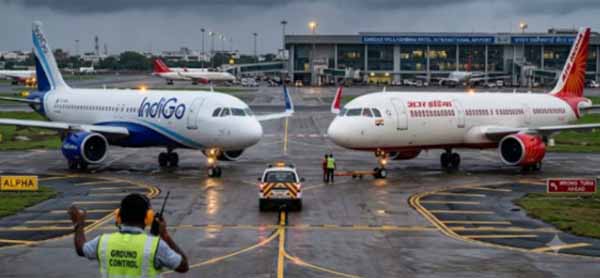
AHMEDABAD, Jun 25 (INS): Two Airbus A320s came face-to-face on a single taxiway
at Ahmedabad airport—the Air India jet coming in from Mumbai took a wrong turn
post-landing and Indigo was taxiing to take off for Mumbai. They came as close
as 200 metres before coming to a halt.
No passengers or crew were harmed. The Directorate General of Civil Aviation
(DGCA) has launched a probe into the lapse.
The incident took place at the Sardar Vallabhbhai Patel International Airport
on Wednesday at around 6:30 pm IST, according to a late report.
The Air India flight was AI2493 (Mumbai–Ahmedabad, Airbus A320, VT-TQV) and
IndiGo flight 6E5160 (Ahmedabad–Mumbai, Airbus A320, VT-IST)
Air India aircraft inadvertently continued straight on Taxiway P instead of
turning right onto Taxiway G. IndiGo aircraft was already taxiing on Taxiway
P for departure. Both planes halted immediately.
When Air India crew missed the designated turn, entering the path of the IndiGo
aircraft, Air Traffic Control (ATC) instructed both crews to halt.
Air India aircraft was later towed back to its parking bay.
IndiGo flight departed after a 20-minute delay and landed safely in Mumbai
later.
Both aircraft are narrow-body Airbus A320-family jets, commonly used for domestic
routes.
Air India said in a statement: “Inadvertently took a wrong turn during taxiing.
No compromise on passenger or crew safety.” And IndiGo said: "Confirmed brief
delay; emphasized that both aircraft remained at a safe distance."
The DGCA has initiated investigation into the incident.
Operational Risk: Taxiway incursions are rare but serious, as ground
collisions can cause catastrophic damage even at low speeds. Standard operating
procedures require immediate halts when conflicting taxi movements occur.
The incident follows other Air India operational lapses under DGCA scrutiny,
including a go-around near Amritsar that briefly infringed Pakistani airspace.
The incident highlights the need for corrective measures such as enhanced taxiway
signage, stricter crew training and procedural revisions to prevent major accidents
on the ground.
Taxiway vs runway operations
Runway: Designed for takeoff and landing. aircraft accelerate to high
speeds—typically 250–300 km/h (135–160 knots) for takeoff, and land at around
240–280 km/h (130–150 knots) depending on weight and type.
Taxiway: Connects runways with terminals and hangars. Speeds are kept
low—usually 20–40 km/h (10–20 knots)—to maintain control and avoid ground collisions.
Operational differences
Runway operations: High-energy phases. Engines at full thrust, braking
systems under maximum load, and aircraft weight concentrated on landing gear.
Taxiway operations: Low-energy phases. Engines at idle or low thrust,
steering via nose wheel, with ATC guiding movements like road traffic.
Risk and damage potential
Runway collision: Catastrophic. At takeoff/landing speeds, the kinetic
energy is enormous. Even partial contact can destroy aircraft structures and
cause mass casualties.
Taxiway collision: Still dangerous, but relatively contained. At low
speeds, damage is usually limited to fuselage dents, wingtip strikes, or landing
gear stress. Casualties are rare unless evacuation is mishandled.
On runways fatality risk is high because of speed, fuel load, and momentum.
History of accidents show hundreds of lives lost in seconds.
On taxiways incidents more often result in delays, minor injuries, and repair
costs. The danger lies in fire risk if fuel tanks or engines are compromised,
but ATC vigilance usually prevents escalation.
For the common man, runway error means high-speed, high-risk, high-casualty
potential. And taxiway error means low-speed, lower-risk, but still serious
operational lapses can occur.
Even “minor” taxiway incursions are red flag symptoms of procedural gaps that,
if repeated on a runway, could be disastrous.






 )
)