WASHINGTON, Jun 24 (INS): President Donald Trump has ripped at Senators who
voted for the War Powers Resolution which he said is “poorly timed and meaningless”
as the war itself is "nearing completion." He claimed the vote undermined his
negotiating position with Iran.
Trump lashed out on Truth Social on Tuesday night at “Four Republican Losers”
and the “Dumocrats” who voted in the Senate to pass a war powers resolution
targeting the President.
The war powers resolution directs Trump to end the ongoing war with Iran or
get Congress’ authorization to continue it.
He said it “just made my job more difficult.” He said he will still get done
“one way or the other, because I always get it done!”
A 60-day negotiating period aimed at securing a long-term agreement between
US and Iran started on Sunday in Switzerland. The direct peace and technical
negotiations began at the Buergenstock resort, with the goal of ending the ongoing
conflict
Many GOP lawmakers are increasingly concerned over the Administration’s handling
of the war.
The war also has had profound economic impacts and is making Trump unpopular
among Americans.
What the resolution says
The bipartisan vote was intended to curb his military authorities. The resolution
directs the administration to halt military operations against Iran or seek
explicit congressional approval, delivering a significant legislative rebuke
to the White House.
It directs the President to remove American military forces from the conflict
with Iran. It gave a 30-day window to halt actions unless explicit congressional
authorization or a formal declaration of war was granted.
Taking to Truth Social, President Trump did not hold back his fury, “So, I
have Iran on the 'ropes,' ready to go down for the fall, willing to give us
practically anything... and the U.S. Senate decides to have a poorly timed and
meaningless War Powers Act Vote,” Trump wrote. He accused the lawmakers of sending
a message of weakness to Tehran, asserting that the vote “provided aid and comfort
to the enemy” and had “just made my job more difficult.”
The President insisted his administration is on the cusp of finalizing a permanent
peace deal to reopen the Strait of Hormuz.
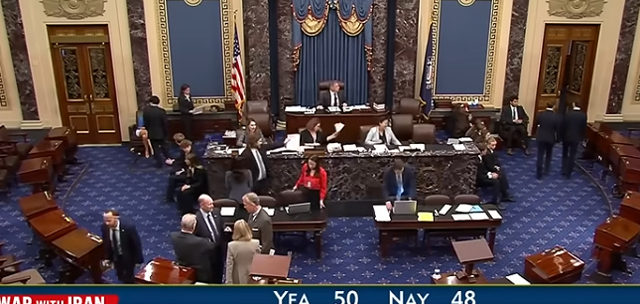
The measure passed the upper chamber in a narrow 50–48 vote, following a similar
victory in the House of Representatives earlier this month. The success of the
concurrent resolution was made possible after four Senate Republicans—Rand Paul
of Kentucky, Susan Collins of Maine, Lisa Murkowski of Alaska, and Bill Cassidy
of Louisiana—broke ranks to vote with the Democrats. The absence of two key
Republican senators, including former Majority Leader Mitch McConnell, ultimately
cleared the path for the slim majority.
Administration officials downplayed the vote as a purely symbolic gesture.
They argued that concurrent resolutions do not carry the force of law and that
active hostilities have technically paused. However, legal experts and lawmakers
warn of deep future consequences.
The meaning of a resolution
This whole situation is a political chess match rather than a legal roadblock.
Because it was passed as a concurrent resolution (voted on by both the House
and Senate, but not sent to the President for a signature), it does not carry
the force of law and has no statutory binding.
Essentially, it functions as "soft law" or a formal statement.
Why did Congress use a concurrent resolution?
It all comes down to avoiding a veto. If Congress had passed a joint resolution
or a standard bill, it would have gone straight to Trump’s desk, where he would
have vetoed it instantly. Congress currently lacks the two-thirds majority vote
required to override a presidential veto.
By using a concurrent resolution, they bypass the President entirely. It allows
Congress to officially put their disapproval on the record without giving the
President the satisfaction of a veto.
If it’s not legally binding, why is it a big deal?
Even though it won't legally force Trump to pull troops back, it carries heavy
political and constitutional consequences:
Political signal of weakness: Trump’s main frustration ("aid and comfort
to the enemy") stems from the fact that it tells foreign adversaries like Iran
that the US Government is fractured and the President doesn't have a unified
country behind his military actions.
Funding leverage: While the resolution itself doesn't stop a war, it
signals that a majority of Congress is hostile to the conflict. This is a massive
warning shot because Congress does hold the power of the purse. If the war drags
on, they can refuse to fund it in future budget bills.
Future Precedent: It acts as a formal constitutional marker. If a future
administration gets dragged into a long, unauthorized conflict, lawmakers can
look back at this bipartisan vote as a precedent for challenging executive overreach.






 )
)