CALICUT (Kozhikode), Sept 7: Eleven of the 38 people quarantined in the Calicut
Medical College hospital for suspected contact with the 12-year old boy in Kozhikode who died of Nipah virus infection on Sunday, have shown symptoms of the disease and their swab samples have been sent to the National Institute of Virology
(NIV) in Pune.
After the deceased boy's sample tested positive for the fruit bat-caused viral
infection at the NIV, an intensive contact tracing was launched and 251 people
have been isolated. The 38 currently lodged in isolation in the medical college
hospital include the boy's parents and relatives and some health workers. Of
the 251 contacts traced, 129 are health workers. The boy was first taken to
a clinic with high temperature on Aug 27 and he was shifted to a private hospital
from where to the medical college. However, again he was moved to another private
hospital. A large number of people and health workers would have come into contact
with the boy, it is presumed.
The health authorities are looking into previous death cases in the region
to see if the infection was running earlier also.
The prevailing restrictions in view of the covid pandemic is expected to safeguard
the people against the Nipah to a great extent.
Three km area around the victim's house in Chathamangalam panchayat has been
segregated and cordoned off. It has been declared containment zone.
Meanwhile, the Pune institute is setting up a lab in the medical college to
expedite testing. The ICAR-National Institute of High Security Animal Diseases,
Bhopal, will undertake blood tests of the pets and other animals around. The
boy's house had been keeping goats.
The Central team that is surveying the place is reported to have found a half-eaten
rambutan fruit around the dead boy's house. They also found that there is a
bat habitat. The boy's parents are reported to have told the visiting team that
the boy had consumed a rambutan fruit a few days earlier.
Nipah virus infection is a zoonotic disease transmitted to people from animals.
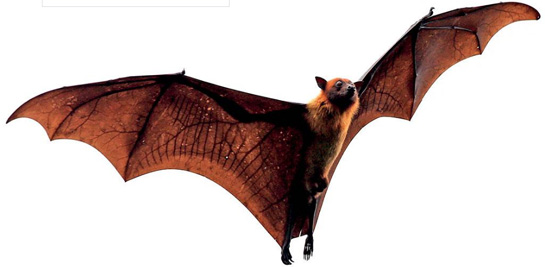
Fruit bats are the natural host. The initial symptoms of the deadly virus are
similar to those of viral fever. The mortality rate is very high at 40-75%.
Fruit bats are the carriers of the Nipah virus and their saliva and excretion
transmit the infection. They do not show symptoms but pass on the virus to animals
like pigs who subsequently die.
The virus infects human beings through contact with saliva and excretion, especially
when eating fruits bitten by the bats. It can also spread by eating partially
cooked meat of infected animals. It is transmitted human to human through secretions
like nasal droplets, saliva or by blood. The main medium is contaminated foods
and drinks.
Fruit bats eat all types of fruits like bananas, mangos, dates, chickoos, avocados,
wild dates, any type of pulpy fruit. The bat always eat only part of a fruit.
An infected bat passes on the virus to the fruit through the saliva. Its teeth
are so small that simple bites may be invisible on the fruit, often going unnoticed
while consuming. It remains live up to three days. Bats show no signs of infection.
But pigs get sick. Dogs, goats, cats, horses and possibly sheep can also be
infected.
A person infected with NiV may have a fever, headache, cough, sore throat and
vomiting. Severe symptoms include difficulty breathing, disorientation, seizures,
coma and brain swelling (encephalitis).
Nipah has an incubation period that can range from 3 to 14 days, following
exposure to the virus. Anytime after three days of infection symptoms can start.
Initial symptoms include fever and headache. it leads to signs of respiratory
illness such as cough, sore throat and difficulty in breathing.
Transmission
Bat-bitten fruits, its saliva and secretion are the primary source of infection
for human beings. There can also be a secondary infection via infected animals
like pigs. Human-to-human transmission results from direct contact with respiratory
and other secretions or blood. Since Nipah is largely a contagious disease,
transmission can take place through fomites. Contaminated food and water are
the major sources of infection, unlike covid which infects only through respiratory
route.
The symptoms of Nipah infection are:
- Fever
- Headache
- Cough
- Sore throat
- Difficulty breathing
- Vomiting
- Coma
- Neurological signs
- Encephalitis
Treatment
There is no medicine nor vaccine for Nipah infection . A vaccine is under development.
Treatment is supportive care only.
Prevention
- Keep away from areas inhabited by bats and pigs
- Avoid consumption of raw date palm sap
- Avoid eating fruits that may be contaminated by bat's secretion or bitten
by them
- Practice handwashing regularly with soap and water
- Avoid contact with infected people and their body fluids like nasal or respiratory
droplets, urine, blood etc.
Nipah virus infection can be diagnosed by RT-PCR test of samples of throat
and nasal swabs, cerebrospinal fluid, urine and blood. Antibodies can be tested
using an enzyme-linked immunosorbent assay (ELISA).
History of Nipah outbreaks
The first Nipah outbreak in Kerala was reported on May 19, 2018 in Kozhikode
district. Seventeen people died. The outbreak was contained in about two months.
Studies that followed concluded that the Nipah was transmitted from fruit bats.
On June 4, 2019 the Kerala Government declared a state of high alert in the
districts of Ernakulam, Thrissur and Idukki following confirmation of a viral
case in Ernakulam. The patient, a student , disclosed that he had eaten a rotten
guava two weeks before he was admitted to hospital on June 3, 2019.
Earlier, there was a Nipah outbreak in Siliguri in 2001 which claimed 45 lives.
Five people died of the infection in Nadia in Bengal in 2007. Then came the
Kerala outbreak of 2018 and the sole incident of 2019.
The outbreak was first recorded in Malaysia where it had reportedly killed
over 100 people in 1999. Over 10 lakh pigs were also killed to control the outbreak.
Indonesia was also affected. Later it came to India and Bangladesh.
Tamil Nadu
COIMABTORE: After Kerala, a Nipah virus infection case has been allegedly
detected in Coimbatore in Tamil Nadu bordering Kerala. However, Coimbatore District
Collector GS Sameeran confirmed on Monday that no case of the Nipah virus has
been detected in Tamil Nadu yet.







 )
)