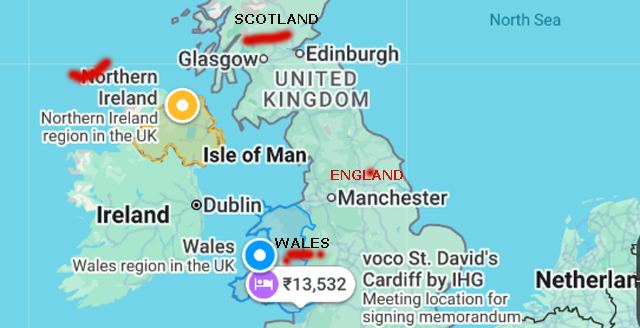
CARDIFF (Wales), Sept 15 (INS): The leaders of Scotland, Wales and Northern
Ireland have signed a joint memorandum of understanding (MoU) declaring their
right to self-determination and calling on the UK Government to prepare for
constitutional change. This is not a declaration of total independence yet,
but a coordinated political declaration by nationalist parties.
The historic Memorandum of Understanding (MoU) was signed on Monday, September
14, during a rare joint summit in Cardiff, the Capital of Wales.
The pact was signed by Scottish First Minister John Swinney, Welsh First Minister
Rhun ap Iorwerth, Northern Ireland First Minister Michelle O’Neill and Sinn
Fein president Mary Lou McDonald.
The agreement does not legally or immediately pull any of the three regions
out of the United Kingdom.
For the first time since devolution began, the largest parties in Scotland
(SNP), Wales (Plaid Cymru) and Northern Ireland (Sinn Fein) are all led by figures
committed to independence of Scotland and Wales and reunification for Northern
Ireland.
The text asserts that Westminster has no right to block democratic paths to
self-determination, though each nation plans to pursue its future in its own
time and way.
Under current UK law, Scotland and Wales cannot legally hold binding independence
referendums without direct approval from the UK Government in London.
Prime Minister Andy Burnham’s administration has rejected the pact, stating
that the Government is focused on economic issues rather than constitutional
division.
Good Friday Agreement
Northern Ireland operates under the Good Friday Agreement, meaning a vote on
Irish unity depends on a provision triggered by the UK Secretary of State if
public support for reunification appears likely.
The overarching goal of these nationalist parties is eventual independence
for Scotland and Wales and Irish reunification. However, because they cannot
legally secede overnight, this MoU outlines a coordinated strategy for short-term
and medium-term demands if they cannot get immediate independence.
The text of the MoU states: “For people watching across these islands — for
people watching around the world — there could be no clearer sign that Westminster's
time is coming to an end.”
The MoU asks London to "prepare, plan and facilitate constitutional change".
The text explicitly notes: “No Westminster Government has the right to block
democracy or undermine the principle that our people will decide their own future.”
Short of full independence, they want greater regional autonomy right now.
For example, Welsh ministers are pushing for adjustments to the Barnett formula
to secure fairer, increased funding from the UK treasury.
All three nations want to position themselves to rejoin the European Union
(EU)—Scotland and Wales as independent member-states, and Northern Ireland through
a unified Ireland.
Bypass London, cooperate directly
The leaders have agreed to bypass London to cooperate directly with each other
on four critical areas: the economy, energy, jobs, and international relations.
This is because the agreement is not a proposal for an "association" or partial
self-rule within the UK. Instead, it is a statement of intent to pursue total
separation. Rather than listing what London keeps, the leaders explicitly detailed
the specific sectors where they are completely bypassing the UK Government to
cooperate with each other right now.
They will now set up inter-regional trade strategies and align manufacturing
networks. Eventually they want to join EU.
Scotland and Wales want total independence as separate, sovereign nations.
If they achieve this, no subjects would be left for the UK; they would take
full control of their own defence, foreign affairs, currency and borders.
Northern Ireland (Sinn Fein) does not want to be an independent micro-state.
They want Irish reunification, merging entirely into the Republic of Ireland.
The MoU glosses over the exact mechanics of a future breakup. Instead, it focuses
entirely on the first step: forcing London to "prepare, plan and facilitate"
the handover of all constitutional powers.
The MoU functions as a de facto declaration of intent to separate, stopping
just short of a legal break. They are trying to create a political reality that
forces the UK Government's hand. However, moving from this declaration to actual
separation faces massive challenges.
A violent or physical conflict remains highly unlikely although cannot be ruled
out.
US President Donald Trump vocalising his support for Irish reunification during
a visit to Dublin the other day is pertinent.
(Go to site: Trump
favours Irish unification)






 )
)