WASHINGTON, Sept 15 (INS): The US has disclosed that it has deployed weapons
in space. It has not elaborated what type of weapons or when they were stationed.
But the systems could include kinetic and non-kinetic capabilities (such as
electronic warfare or co-orbital tools) designed to disrupt or disable adversary
assets.
Since weaponisation of space is comparatively new to defence strategies, there
is no comprehensive international law already existing that prohibits exploitation
of space for national security or warfare.
A high-ranking official announced on Monday that the US military has deployed
weapons into orbit to counter threats from Russia and China.
US Air Force Secretary Troy Meink was addressing the annual Air, Space and
Cyber Conference hosted by the Air and Space Forces Association in the National
Harbor, Maryland.
Meink confirmed for the first time that the US military has fielded "on-orbit
space control weapons capable of defending the Joint Force against hostile adversary
action", though he did not provide specific details on the exact technology
or when the launch took place.
The US had set up a Space Force in 2019 during during President Donald Trump's
previous term. The US is the first country known to have placed weapons in space.
The US now has on-orbit space control weapons capable of defending the joint
force against hostile adversary action, according to Meink.
China and Russia react
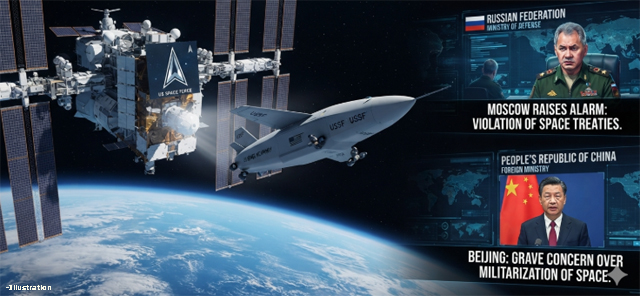
China and Russia, US' potential rivals, have expressed alarm over the development.
“We urge the US side to stop expanding its military capabilities and preparing
for war in outer space,” Chinese foreign ministry spokesman Guo Jiakun said.
Russia called for space to remain completely demilitarized—even though both
maintain robust covert programs.
Meanwhile, defence experts point out that these weapons do not necessarily
constitute "kinetic" arms but mostly communication equipment.
However, the on-orbit systems could include both defensive or offensive counter-space
operations. The new technologies can degrade, disrupt or destroy adversarial
capabilities via electronic, cyber or physical means. There could be space-based
interceptors using fast-developing hardware linked to missile-defence initiatives
like the proposed "Golden Dome" shield.
What are the dangers
Destroying or damaging objects in space creates thousands of high-speed shrapnel
pieces that can trigger chain-reaction collisions, destroying civilian weather,
communication, and navigation satellites.
Hitting critical orbital assets can instantly paralyze global navigation, financial
transactions, weather forecasting, and disaster response systems.
The announcement has escalated geopolitical tensions with rivals like China
and Russia also likely planning orbital systems, increasing the risk of turning
outer space into an active battlefield.
The 1967 Outer Space Treaty: Gaps and Legality
The relationship between the Kessler Syndrome, the 1967 Outer Space Treaty,
and Chinese and Russian space programs highlights why the US deployment of space
weapons is so critical and dangerous.
The 1967 Outer Space Treaty (OST) is the foundation of international space
law, but it contains a massive loophole that the U.S., Russia, and China are
exploiting.
It explicitly prohibits nations from placing nuclear weapons or other weapons
of mass destruction (WMDs) into Earth's orbit or on celestial bodies.
But The treaty is completely silent on conventional weapons, dual-use military
satellites, and non-kinetic weapons (like lasers, cyber tools, or jamming systems).
Because the US military's recently acknowledged "space control" weapons are
conventional and non-nuclear, the U.S. Space Force maintains that these deployments
fully comply with the treaty.
China and Russia have pushed for a new UN treaty called the PPWT (Prevention
of the Placement of Weapons in Outer Space), which would ban conventional orbital
weapons. The US has repeatedly rejected it.
Chinese, Russian space programs
The US claims that there is rapid, aggressive weaponization of space by its
rivals Russia and China, which have treated space as an active warfighting domain.
Beijing is developing highly advanced counter-space options, including nuclear-capable
fractional orbital hypersonic missiles, co-orbital robots with robotic arms
capable of snatching satellites, and directed-energy lasers designed to blind
US surveillance.
The US had warned that Russia is working on a space-based nuclear weapon designed
to detonate a devastating Electromagnetic Pulse (EMP) to wipe out massive satellite
networks.
The Kessler Syndrome: The ultimate risk
The weaponisation of space brings humanity closer to a catastrophic tipping
point known as the Kessler Syndrome.
Coined by NASA scientist Donald Kessler, this theory dictates that if the density
of objects in Low Earth Orbit (LEO) becomes too high, a single collision will
create thousands of pieces of fast-moving shrapnel. This shrapnel will hit other
satellites, triggering an unstoppable, cascading chain-reaction of destruction.
In its latest report, the European Space Agency (ESA) warned that Earth's orbit
is already showing early signs of this self-reinforcing process due to massive
commercial mega-constellations.
While the US favors non-kinetic warfare (like cyber jamming) to avoid creating
debris, the temptation to use kinetic weapons (missiles or physical smashers)
in a hot conflict is high. Past anti-satellite missile tests—such as Russia
blowing up its own Kosmos 1408 satellite in 2021—have already generated thousands
of trackable debris shards that actively threaten the International Space Station
and civilian networks.
In a space war, Low Earth Orbit could become a chaotic, impenetrable field
of high-speed junk. China, Russia and the US have already conducted anti-satellite
tests in the recent past.









 )
)