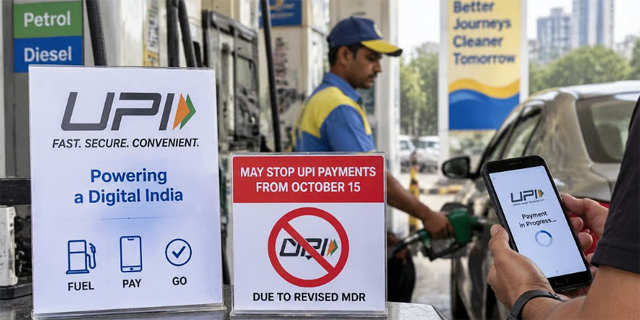
NEW DELHI, Sept 18 (INS): Petrol pump dealers across India have threatened to stop accepting Unified Payments Interface (UPI) payments of Rs 2,000 and above and switch to cash only
payment unless the Government withdraws the merchant discount rate (MDR) of
Rs 5 per transaction.
They have warned that they will stop accepting UPI payments of Rs 2,000 and
above starting October 15 (when it takes effect).
They claim the charge would reduce their margins, which is very small already,
estimated between Rs 2.40 and Rs 3.40 per litre. MDR at any level is an additional
burden and unacceptable for them.
The Rs 5 fee is charged to the merchant (the petrol pump), and not directly
added to the customer's bill.
Oil marketing companies decide fuel prices and dealer commissions, leaving
pumps unable to pass the cost easily.
The All India Petroleum Dealers Association, led by president Ajay Bansal,
wrote to the Finance Minister to ask for a full exemption.
“We may have to stop accepting UPI payments of Rs 2,000 and above if exemption
is not allowed to fuel retailers,” Federation of All India Petroleum Traders
(FAIPT) spokesperson Monty told HT.
There are over 1 lakh petrol pumps across the country. More than 90% of them
are operated by Indian Oil Corporation (IOC), Bharat Petroleum Corporation Ltd
(BPCL) and Hindustan Petroleum Corporation Ltd (HPCL). (Individual private franchise
owners/dealers manage and run day-to-day operations under the PSU networks)
The All India Petroleum Dealers Association (AIPDA) said, “Petrol and diesel
are essential commodities, and fuel purchases are inherently high-value transactions.
Consequently, payments exceeding Rs 2,000 are routine at petrol pumps, making
UPI one of the most widely used digital payment modes by customers.”
Types of merchants, variable and non-variable fees
Under the new National Payments Corporation of India (NPCI) framework starting
October 15, 2026, merchant categories are treated differently based on their
transaction volume, profit margins, and industry type
The rules segregate merchants into three distinct structural buckets:
1. The Standard 0.4% Variable MDR Rate
Most large enterprise businesses, retail chains, e-commerce giants, and electronics
stores fall into the standard category.
Rate: 0.4% MDR on eligible person-to-merchant (P2M) payments exceeding
Rs 2,000
Capping structure: The fee scales linearly up to a maximum cap of Rs
300 for high-value transactions of Rs 75,000 and above.
Examples:
Buying clothes worth Rs 3,000 at a retail outlet will cost the store Rs 12.
Booking a Rs 10,000 hotel stay will cost the property Rs 40.
Purchasing a high-end laptop worth Rs 80,000 will hit the cap, costing the
retailer a maximum of Rs 300
2. Concessional fixed flat Rs 5 rate
Like petrol pumps, other specified thin-margin or essential public services
are protected from variable percentage-based costs to ensure digital efficiency.
Regardless of whether the transaction is Rs 3,000 or Rs 30,000, they pay a single
flat Rs 5 fee for transactions above Rs 2,000.
Railways: Ticket bookings via online portals or station counters.
Telecommunications: Large bulk recharge cycles or monthly broadband/postpaid
bills.
Insurance providers: Annual or semi-annual high-value premium payments.
Agricultural inputs: Fertilizer, seed and farming equipment distributors.
Utilities: Electricity, water and other State gas pipeline bill payments.
3. Special capital market rate
Rate: Investment and trading firms attract a minimal 0.02% MDR, also
capped at ?300
Examples: Transactions routed through stockbrokers, mutual fund houses
and securities wealth management platforms
Who is exempt from the new MDR rule?
Small vendors (P2PM Category): Street vendors, neighborhood kirana stores
and small businesses making up to Rs 1 lakh a month via UPI QR codes remain
at zero MDR, even if an individual single transaction goes past Rs 2,000.
UPI auto pay and mandates: Standing automated instructions for OTT subscriptions,
recurring investments (SIPs) and utility mandates remain entirely free.
There are strict rules against passing these fees onto the customer.
PIL in Supreme Court
Meanwhile, a Public Interest Litigation (PIL) has been filed in the Supreme
Court of India challenging the Central Government's decision to roll back the
statutory zero-MDR protection for UPI transactions exceeding Rs 2,000.
The petition was filed by advocate Anjan Datta. It explicitly names the Union
Government, Reserve Bank of India (RBI), National Payments Corporation of India
(NPCI) and the UPI and Services Steering Committee as the respondents.
The petition argues that the government has not disclosed any data, impact
assessment, or clear methodology to justify why Rs 2,000 was chosen as the threshold,
or why Rs 1 lakh monthly revenue was set as the exemption limit for small vendors.
He says that a framework of this scale should not be enforced based merely
on a press release and steering committee FAQs. Again, who and how the threshold
was fixed? Essential rate-making and fiscal matters cannot be left entirely
to executive discretion.
Footnote: There were incredibly simple, universally acceptable
ways to resolve this framework. But under our current administrative machinery,
such rationality rarely materialises. It is an undeniable
fact that payment gateways and processing banks consume massive amounts of power,
and managing trillions of digital transactions requires heavy infrastructure
and hardware maintenance. Nobody is disputing that these networks cost money
to run. However, if the Government simply charged a flat, painless Re 1 on every
single UPI transaction, it would happen entirely without consumer or merchant
tears and work out seamlessly, without having to hire a few lakhs additional, permanent clerks. Remarkably, a universal Re 1 micro-fee would generate far more revenue
than the current convoluted, variable MDR plan (the result of an unnecessarily
complicated institutional thought process native to India)—a clumsy system whose
massive collection, calculation and bureaucratic costs will likely swallow up
the very revenue it tries to collect. (This simple UPI instance is illustrated here to serve as a window to the wonky system we are in.)








 )
)