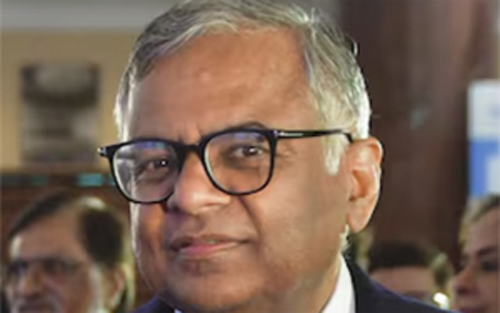
MUMBAI, Sept 17: N Chandrasekaran was re-appointed as Executive Chairman of
Tata Sons for a fresh five-year term, extending his leadership until 2032, on
Thursday as he accepted the board's request to reconsider his decision to quit.
However, Tata Trusts (the majority 66% stakeholder) declared the re-appointment
"illegal" and a "legal nullity".
Therefore, the core impasse has not changed at all.
On August 12, Chandrasekaran had announced he would not seek a third term when
his current tenure expires on February 20, 2027. He cited a lack of unanimity
on the board after months of internal friction. However, on September 3, the
Nomination Remuneration Committee (NRC) unanimously requested him to reconsider
his decision, culminating in his formal acceptance at the board meeting on Thursday.
The Tata Sons board passed the reappointment resolution by a majority vote
with 4 directors voting in favour.
Tata Trusts Chairman Noel Tata was the lone dissenter, voting against the extension.
Tata Trusts claims that under the holding company’s Articles of Association,
any appointment or reappointment of a chairman requires the unanimous support
of both Trust-nominee directors. Because Noel Tata vetoed it, the Trusts assert
the board's decision is legally void.
Situation remains unchanged
When Chandrasekaran announced his decision to step down, he explicitly stated
it was because a proposal for his extension on February 24, 2026, could not
be carried through due to a lack of unanimity on the board.
The present "reappointment" by the board has not solved that deadlock—it has
only bypassed it temporarily through a aggressive majority vote. The situation
remains identical in the following critical ways:
The veto remains: Noel Tata voted against the reappointment. Because Tata Trusts'
Articles of Association rules require the unanimous backing of its nominee directors,
Noel Tata's single "no" vote means the Trusts still view the entire action as
legally void.
The strategic rifts are unresolved: The underlying friction points that led
to the original gridlock—the fight over a mandatory Tata Sons public listing
(IPO) and capital allocations to loss-making ventures like Air India—remain
completely frozen.
Noel Tata's Hard Stance: In his official statement at the board meeting, Noel
Tata flatly stated, "The page has turned... it is now time to move on." He reiterated
that Chandrasekaran's initial decision to leave was final and that the company
should proceed with a succession committee.
Chandrasekaran vs. Noel Tata—Strategic war
By accepting the board's request to stay, Chandrasekaran has transitioned his
position from a "lack of unanimity" into an open, public corporate war with
the 66% majority shareholder. The fundamental roadblock that caused his resignation
is still fully intact.
The split follows deep-seated differences between Chandrasekaran and Noel Tata
over corporate direction.
The Reserve Bank of India (RBI) recently rejected Tata Sons' request to bypass
its mandatory listing rules for "upper-layer" NBFCs. While the board moved ahead
with planning a potential public listing to comply with the RBI, Noel Tata explicitly
read out his opposition to an IPO during the meeting.
Noel Tata had previously raised concerns regarding mounting capital deployment
and heavy losses in newer ventures like Air India and Tata Digital (BigBasket/Tata
Neu).
Market reaction
Despite the governance dispute, investors reacted favorably to the prospect
of leadership continuity. Shares of major listed group entities—including Tata
Chemicals (up 14%), Tata Investment Corporation, and TCS—rallied significantly
following the announcement.
Both the reappointment and the listing roadmap will ultimately require final
approvals at the company's upcoming Annual General Meeting (AGM), setting up
an unprecedented showdown between the board and its parent trusts.
AGM meeting—battleground
Now the Annual General Meeting (AGM) of Tata Sons will be the central battleground
for the unfolding power struggle within the Tata Group.
The 108th AGM was originally scheduled for August 18, 2026. However, in a historic
first for the holding company, the meeting had to be adjourned due to a lack
of quorum.
Following the failure of the August meeting, Tata Sons sought and received
a three-month legal extension from the Registrar of Companies (RoC). The new
tentative date is December 31.
Under Tata Sons' Articles of Association, the AGM cannot proceed without a
strict quorum requirement: at least five members must be present, which must
include a jointly nominated representative from the two primary philanthropic
bodies—the Sir Dorabji Tata Trust and the Sir Ratan Tata Trust (SRTT).
The meeting hit a legal wall because the Maharashtra Charity Commissioner issued
a restraining order that froze the board proceedings of the Sir Ratan Tata Trust.
Because the trust could not legally meet to nominate its joint representative,
the quorum could not be completed, forcing the immediate adjournment of the
AGM.
When the shareholders finally meet, the AGM will face two corporate issues.
The Re-appointment of N. Chandrasekaran: While the Tata Sons board passed a
majority resolution on September 17 to give Chandrasekaran a third 5-year term,
the appointment is not final until it is ratified by shareholders at the AGM.
Because Tata Trusts controls 66% of the voting power and its Chairman, Noel
Tata, has declared the board's decision "illegal," the Trusts are reportedly
positioning to vote down and oust Chandrasekaran at the AGM.
The second is the mandatory public listing (IPO). The shareholders will also
have to vote on the RBI's mandatory public listing requirement for Tata Sons.
The board wants to initiate compliance steps, whereas Noel Tata has aggressively
demanded the company legally fight the RBI order.
Previous Report: N Chandrasekaran resigns






 )
)